
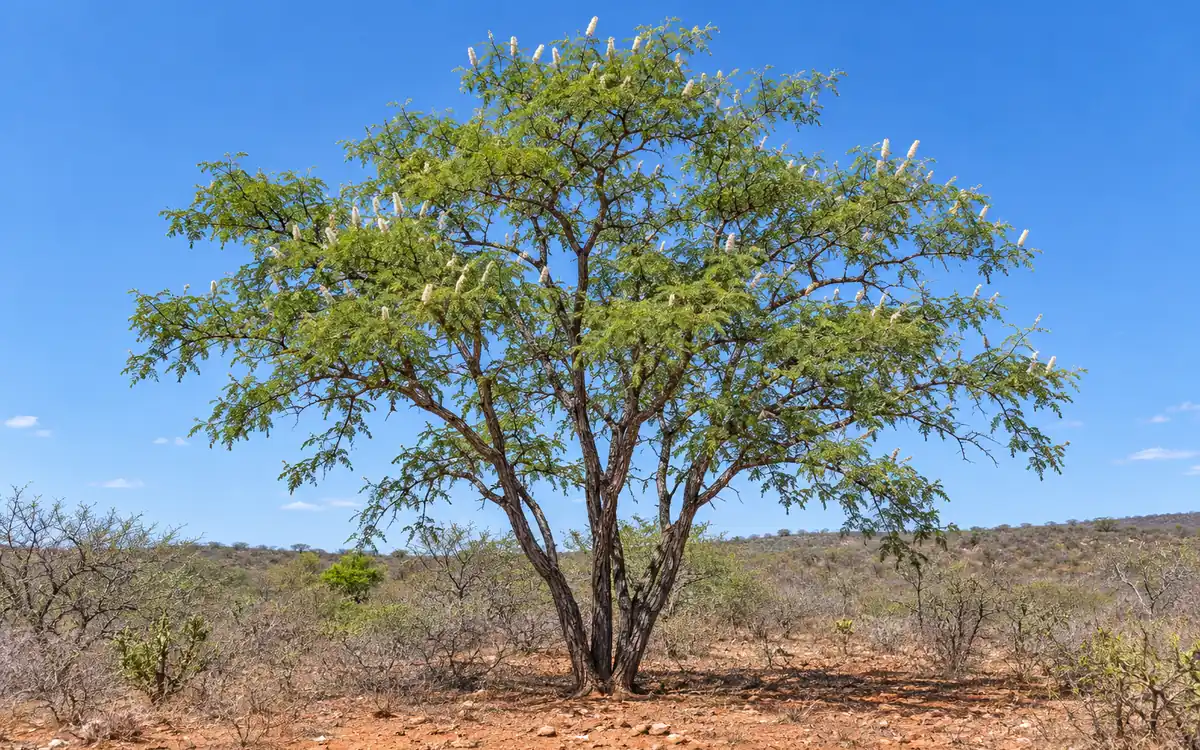
In short: The Mimosa hostilis tree (Mimosa tenuiflora) is a thorny, drought-tolerant tree from Mexico and Brazil that can reach about 8 meters (26 feet). For outdoor planting, USDA Zone 9 or higher is recommended; in colder areas it is grown in pots or greenhouses. Seeds sprout in one to two weeks, and the tree takes 8 to 10 years to reach full size.
Mimosa hostilis, also known as Mimosa tenuiflora, is a shrub or small tree highly valued for its hardiness, rapid growth in the early stages, and many traditional uses. It is easily recognized by its reddish trunk, small leaves that grow in linear pairs, and white or pale yellow spike-like flowers. Additionally, it can be grown both in pots and directly in the ground, provided it receives the right conditions.
If you’re wondering how long it takes for Mimosa hostilis to grow, the answer depends on factors such as germination, climate, soil, light exposure, and care during its early years. Even so, its growth depends on climate, soil and care.
What does a Mimosa hostilis tree look like?
A full-grown Mimosa hostilis tree is a small to medium-sized, thorny tree with fern-like foliage. These are its main features:
| Feature | Description |
| Scientific name | Mimosa tenuiflora; Mimosa hostilis is a synonym. Legume family (Fabaceae). |
| Common names | Tepezcohuite in Mexico, jurema preta in Brazil. |
| Full-grown height | Up to about 8 meters (26 feet). |
| Leaves | Finely divided and fern-like, up to 5 cm (2 in) long, with 15 to 33 pairs of small leaflets. |
| Flowers | White and fragrant, in loose cylindrical spikes 4 to 8 cm (1.6 to 3 in) long. |
| Seed pods | Brittle pods 2.5 to 5 cm (1 to 2 in) long, each holding 4 to 6 flat, light brown seeds. |
| Bark | Dark brown to grey outside, reddish brown inside. |
| Native range | Southern Mexico to northeastern Brazil. |
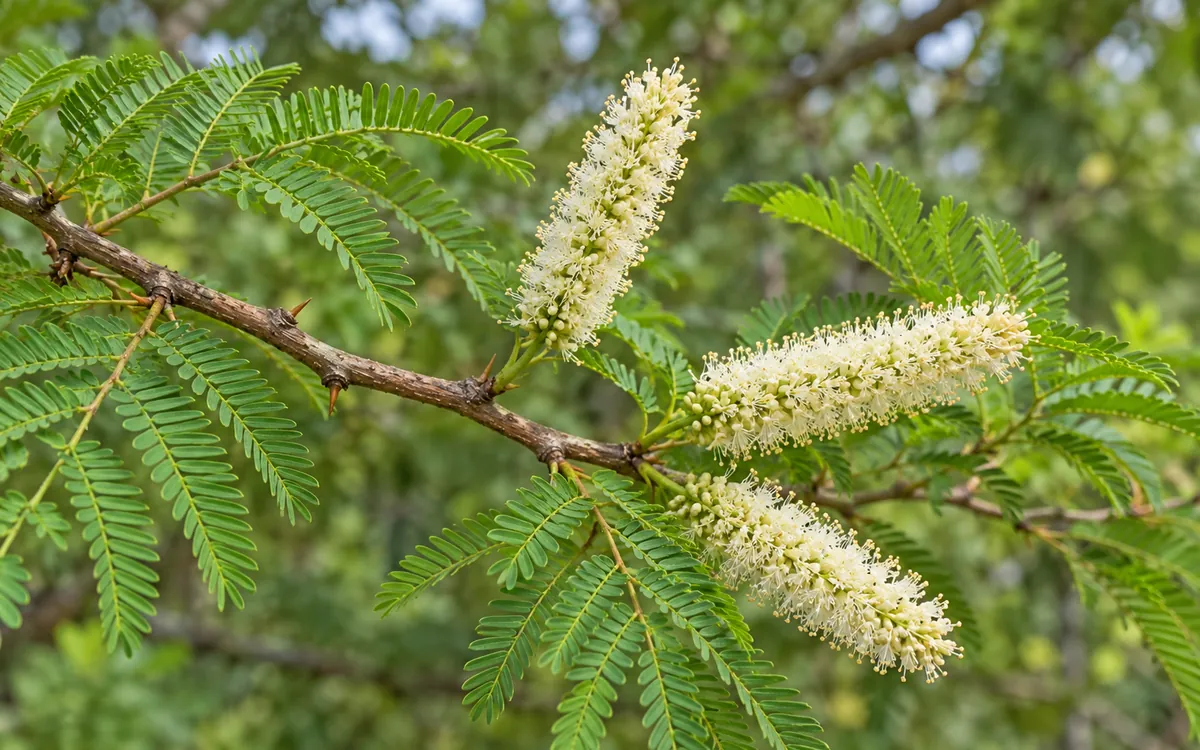
A botanical reference reports flowering and fruiting from November through June.
Not the same as the mimosa or silk tree
In the United States, “mimosa tree” usually means the silk tree (Albizia julibrissin), a different species with pink, fluffy flowers. Mimosa hostilis has white flower spikes and thorns. It is also a different plant from Mimosa pudica, the small sensitive plant; see Mimosa pudica vs. Mimosa hostilis. For more on the plant and its uses, read our guide to Mimosa hostilis.
How long does it take for Mimosa hostilis to grow?
Mimosa hostilis begins to show growth shortly after germination. Under suitable conditions, its seeds can sprout in approximately 7 to 14 days, and visible growth can be observed within the first 2 to 4 weeks. During the first 2 to 3 years, the plant can reach a height of 1 to 2 meters (3 to 6.5 feet), while its maximum height—which typically ranges from 6 to 8 meters (20 to 26 feet) or even more under favorable conditions—can be achieved over the course of 8 to 10 years.
This means it takes years to reach full size, but it is a species that thrives when provided with good drainage, sufficient sunlight, and a warm environment. In its early years, it focuses much of its energy on developing a strong root system, which later supports more vigorous and stable growth.

Growing Mimosa hostilis
Mimosa tenuiflora seeds can be germinated at home using two simple methods. Both aim to improve seed viability and create the right environment for easier germination.
Method 1: Thermal scarification
This method involves exposing the seed to heat to help break dormancy and promote germination.
- Step 1: Fill a pot or container with water, depending on the number of seeds you’ll be using. Bring the water to a boil, then turn off the heat.
- Step 2: Lightly file each seed and place it in the hot water for about two hours, until it swells and begins to split open.
- Step 3: Cover the seeds with damp paper towels or a damp cloth and place them in a plastic bag. Leave them for seven days in a well-lit spot, out of direct sunlight, keeping them moist at all times.
- Step 4: Once the seeds have sprouted, plant them in a pot with fertilized soil or directly in the ground. If using a pot, do not plant more than two seeds per container. If planting in the ground, leave enough space between each plant.
Method 2: Soaking and Seedling Tray
This method is simpler and also yields good results.
- Step 1: Place the seeds in a glass of water and let them soak for 24 hours.
- Step 2: Fill a seed tray with prepared potting mix. If you don’t have one, you can use an empty egg carton and fill each compartment with moist soil.
- Step 3: Place one to two seeds in each cavity and cover them with a small amount of compost or potting mix.
- Step 4: Place the seed tray in a spot with good light but no direct sunlight. Water frequently to maintain moisture, and in about two weeks, the seedlings should have grown enough to continue developing.
Optimal Growing Conditions
To ensure that Mimosa hostilis grows strong and healthy from the start, it is important to provide it with a favorable environment.
| Aspect | Description |
| Climate and ideal zone | This tropical plant is best suited to warm, frost-free climates. In terms of USDA zone, it grows best in zones 9 to 11. In colder regions, it is best grown in a pot or inside a greenhouse. |
| Sunlight | It needs at least 6 to 8 hours of direct sunlight per day. It tolerates heat well and usually thrives best in open, sunny spaces. |
| Soil type | It prefers sandy, well-drained, slightly acidic soil, with an approximate pH of 5.5 to 6.5. It is best to avoid clay-heavy or compact soils that retain too much water. |
| Watering | Although it can tolerate moderate periods of drought, it needs regular watering during its early stages, especially in dry climates. Once established, it can do well with less frequent watering. |
| Humidity | It tolerates dry environments, but if grown indoors or in a greenhouse, a relative humidity level of 40% to 60% is usually ideal. |
Does Mimosa hostilis grow in the United States?
Mimosa hostilis is not native to the United States, but it can be grown here. For outdoor planting, USDA Zone 9 or higher is recommended. That includes parts of southern Florida, southern Texas, southern Arizona and California.
In colder areas, grow it in a container that can be moved to a frost-free place or in a greenhouse, and protect it from frost. You can check your zone on the USDA Plant Hardiness Zone Map.
Rules on growing plants can also vary by state; see our guide to the legal status of Mimosa hostilis in the United States.
Ongoing Care
Once the plant has germinated and enters its active growth phase, it’s important to follow some basic care guidelines to promote its development.
Fertilization
During the first two years, you can apply a balanced organic fertilizer every 3 or 4 months. A balanced formula helps strengthen roots, leaves, and future flowering.
Pruning
It is not essential, but it can be done to control size or encourage secondary branches. Ideally, avoid drastic pruning before the second year.
Repotting
If the plant is growing in a pot, it is advisable to gradually move it to larger containers, approximately every 6 months, until it can be planted in the ground if desired.
Pest Control
Although it is a hardy plant, it can be affected by aphids, scale insects, or fungi in very humid environments. In such cases, natural treatments such as neem or potassium soap can be used.
Drainage
This is key. Poor drainage can cause root rot and stunt the plant’s growth.
Harvesting Root Bark
One of the main reasons for growing Mimosa hostilis is to harvest its root bark (MHRB), as it contains bioactive compounds that are valuable for cosmetics, dyes, and other traditional uses. However, it should not be harvested prematurely.
It is recommended to wait at least 2 or 3 years before considering a responsible harvest. Ideally, the tree should have produced seeds, reached a height of approximately 1.5 meters (5 feet), and developed substantial thickness in both the stem and the root system. If you wish to extract part of the root without completely compromising the plant, you can take only a lateral section of a secondary root, leaving the main root system intact. Another more responsible option is to grow several plants and harvest only the most mature ones.
Careful harvesting not only helps preserve the plant but also results in higher-quality bark.
Uses of Mimosa hostilis
Mimosa hostilis has been used in various ways over time, both for its properties and for its durability and versatility.
Injuries and Burns
One of its best-known uses is in traditional skin preparations, particularly for treating burns and wounds.
Cosmetics Manufacturing
The bark of this shrub is used to make various types of cosmetic products, such as soaps, shampoos, and moisturizers. Its benefits for the skin have gained popularity over time, especially in formulas designed to promote skin care and a healthy appearance.
There has also been much discussion about its effectiveness in strengthening the scalp and helping to prevent hair loss, which is why it now appears as an ingredient in numerous hair care products.

Ornamental
During its early years, it can be used as an ornamental plant, since it has not yet grown very large and adapts well to pots or sheltered areas. It does not require a large amount of space, just a suitable climate and protection from extreme cold.
Dye
The reddish hue of its bark is used to produce natural dyes, particularly in artisanal processes and in applications related to leather dyeing.
Wood
Although it does not develop an extremely thick trunk, its wood has been used in some contexts for furniture, fences, simple suspension bridges, stairs, and other structures.
Traditional Beverages
In some Latin American countries, especially where it is also known as jurema, the root has been part of artisanal preparations used in traditional and ritual contexts.
Other uses
It has also been used in the reforestation of areas degraded by fire or erosion, thanks to the abundant spread of its seeds in open areas and its relatively rapid growth. Likewise, it has been utilized to improve soil quality and as a food source for some grazing animals, as its leaves and fruits have a nutritional content that is attractive to cows and goats.
Frequently Asked Questions
Does Mimosa hostilis grow in the US?
It is not native to the United States, but it can be grown here. For outdoor planting, USDA Zone 9 or higher is recommended; in colder areas it is grown in containers or greenhouses.
What is the growing zone for Mimosa hostilis?
USDA Zone 9 or higher is recommended for outdoor planting. In colder areas, grow it in a container or greenhouse and protect it from frost.
How tall does Mimosa hostilis grow?
Under favorable conditions, it can reach 6 to 8 meters (20 to 26 feet) over several years, typically between 8 and 10 years.
How long does it take for Mimosa hostilis to grow from seed?
Generally, the seed takes between 7 and 14 days to germinate, and the plant can reach between 1 and 2 meters (3 to 6.5 feet) in its first 2 or 3 years if it receives good growing conditions.
Is Mimosa hostilis the same as the mimosa tree?
No. In the United States, “mimosa tree” usually refers to the silk tree (Albizia julibrissin). Mimosa hostilis (Mimosa tenuiflora) is a different species.
Can Mimosa hostilis be grown indoors?
Yes, but it needs plenty of light, space, and a warm environment. Whenever possible, outdoor cultivation is usually better, except in cold climates.
When can the root bark be harvested?
Ideally, wait at least 2 to 3 years, when the plant is more mature and sufficiently developed.
What climate is best for growing Mimosa hostilis?
Warm, frost-free climates with good sunlight and well-drained soil are best suited for this species.
Last reviewed: October 2026.








1 thought on “Mimosa Hostilis Tree: How to Grow It and How Long It Takes”
Pingback: Is Mimosa Hostilis Root Bark Legal in the US? (2026 Guide)