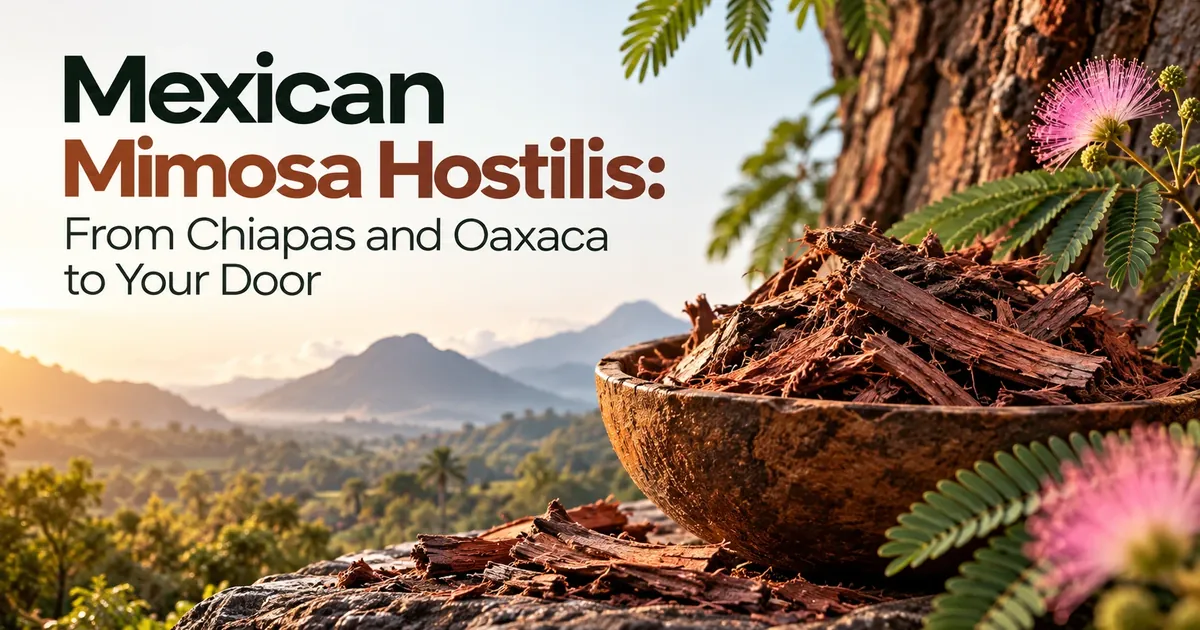

Secrets of Mimosa Hostilis Root Bark go beyond its reddish-brown color and fibrous texture. Also known as MHRB, this botanical raw material is valued for its versatility in natural dyes, craft projects, and personal care products.
Mimosa Hostilis Root Bark is also known as tepezcohuite in Mexico, jurema preta in Brazil, and Mimosa tenuiflora in botanical contexts. Understanding the secrets of Mimosa Hostilis Root Bark means looking beyond its different names and learning about its uses, available forms, quality indicators, and proper storage methods.
In this guide, we explore the most important facts about Mimosa Hostilis Root Bark, including its uses, forms, signs of quality, and what to consider before buying it.
Secret 1: Mimosa Hostilis Root Bark Is Not Just Any Bark
When we talk about Mimosa Hostilis Root Bark, the most important part of the name is “Root Bark.” This is because it refers to the root bark, one of the most highly valued parts of the plant associated with Mimosa tenuiflora. This bark stands out for characteristics that make it especially useful in botanical projects, natural dyes, cosmetic preparations, and artisanal crafts.
Some common characteristics of Mimosa Hostilis Root Bark are:
- Reddish-brown color
- Fibrous texture
- Natural earthy aroma
- Good versatility in different forms
- Frequent use in plant-based projects
Before buying MHRB, it’s a good idea to look beyond the product name. The form, origin, processing, and available information about the bark can make a big difference in your experience using it.
Secret 2: Mimosa hostilis is known by more than 5 different names
One of the things that confuses users the most is that Mimosa hostilis root bark can go by different names depending on the context, country, or traditional use. That’s why it’s common to come across terms like tepezcohuite, Mimosa tenuiflora, jurema preta, or simply MHRB.
Knowing these names helps you better identify the product and understand why it comes up in discussions about botany, natural dyes, skincare, and traditional uses.
The names most commonly associated with Mimosa Hostilis Root Bark are:
- Mimosa Hostilis Root Bark
- MHRB
- Mimosa tenuiflora
- Tepezcohuite
- Jurema preta
- Mimosa Hostilis bark
Although these terms may appear in different contexts, in botanical and artisanal products they usually refer to the root bark used for its color, texture, and versatility.

Secret 3: MHRB’s color explains its value as a natural dye
One of the best-known uses of Mimosa Hostilis Root Bark is in natural dyes. Its reddish-brown hue makes it an attractive raw material for projects where color plays an important role.
Unlike other plant-based ingredients that offer softer or more variable shades, MHRB is valued for its intense pigmentation and botanical origin. This makes it appealing to those seeking plant-based alternatives for creative, textile, or artisanal projects.
Mimosa is often chosen for:
- Natural dyes
- Textile projects
- Handmade soaps
- Botanical preparations
- DIY projects with plant-based ingredients
However, its appeal lies not only in its color, but also in the opportunity to work with a natural, recognizable, and versatile raw material.
Secret 4: Mimosa Hostilis Root Bark powder is the most practical form for many uses
Although MHRB is available as whole bark, crushed bark, or powder, the powdered form is often one of the most practical options. Mimosa Hostilis Root Bark powder blends more easily into cosmetic preparations, handmade soaps, face masks, and other projects that require a fine, uniform texture.
The main advantage of the powder is that it reduces the amount of prep work required. You don’t need to grind the bark before using it in a formulation, which makes it easier to measure, mix, and store the product.
This form is typically useful for:
- Topical face masks
- Handcrafted soaps
- Cosmetic blends
- Botanical preparations
- Projects requiring a uniform texture
That said, the best form depends on your goal. Whole bark offers more control over processing, crushed bark works well for those who prefer an intermediate texture, and the powder is more convenient when practicality is a priority.
Secret 5: Mimosa Hostilis Also Has a Place in Skin Care Products
Mimosa Hostilis root bark is not only sought after for its color or botanical value. It also comes up in discussions about skin care products, especially because of its use in topical preparations, handmade soaps, face masks, and personal care products.
In this context, MHRB is valued for its plant-based origin and for the compounds present in the root bark, such as tannins, flavonoids, and other components of cosmetic interest. For this reason, many people incorporate it into projects focused on external skin care.
Some common uses in skin care products include:
- Handcrafted soaps
- Botanical face masks
- Creams or balms for external use
- Natural topical preparations
- Plant-inspired cosmetic formulas
It is important to understand that Mimosa Hostilis Root Bark works best as a supporting ingredient within a well-formulated routine or preparation. It should not be used as a substitute for dermatological treatments or applied to open wounds, severe burns, or severe irritations without professional guidance.

How can you identify high-quality Mimosa Hostilis Root Bark?
Good-quality Mimosa Hostilis Root Bark isn’t recognizable by its name alone. Its quality is also evident in its color, texture, aroma, and the way the product has been processed.
High-quality root bark typically has a reddish-brown appearance, a fibrous texture, and a natural, earthy aroma. These characteristics help identify a well-preserved botanical raw material suitable for various types of projects.
Before purchasing MHRB, check for the following signs:
- Characteristic reddish-brown color
- Fibrous texture or texture appropriate for the format
- Natural, earthy, and plant-like aroma
- Clear product description
- Information on the form—whether whole, crushed, or powdered
- Absence of additives, fillers, or unnecessary chemicals
Choosing high-quality MHRB enhances the user experience, especially if you plan to work with natural dyes, soaps, cosmetic formulations, or botanical projects. A well-described and properly stored product always inspires more confidence than a bark with no clear information.
How to Store MHRB Properly?
Mimosa must be stored carefully to preserve its color, texture, and aroma for as long as possible. Although it is a dried raw material, moisture, direct light, and heat can affect its shelf life.
Ideally, store MHRB in a cool, dry, and dark place, away from sources of moisture and direct sunlight. If you have Mimosa Hostilis Root Bark powder, proper storage is even more important because the powder has a larger surface area exposed to the air.
For best preservation, use:
- An airtight container
- A cool, dry place
- Protection from direct light
- A label with the date of purchase or opening
- Separation from products with strong odors
- Handling with clean, dry utensils
Proper storage does not alter the nature of the product, but it does help preserve its characteristics. If you purchase MHRB for various projects, storing it correctly will ensure a better user experience over time.
Understanding the secrets of Mimosa Hostilis Root Bark can help you choose the right form, identify quality, and store the product correctly
Where to Buy Mimosa Hostilis Root Bark in the U.S.
If you’re looking for Mimosa Hostilis Root Bark in the United States, choosing a specialty store makes a big difference. It’s not just about finding MHRB in stock, but about purchasing a product with clear information, good packaging, and formats suitable for different uses.
At MHRBUSA™, we offer Mimosa Hostilis Root Bark in various forms, including whole bark, crushed bark, and powder. This allows you to choose the format that best suits your project, whether it’s for natural dyes, cosmetic preparations, handmade soaps, or botanical projects.
When you shop with us, you’ll enjoy benefits such as:
- Shipping from the United States
- Tracked orders
- Secure and discreet packaging
- Various forms of Mimosa Hostilis Root Bark
- Options to buy whole, crushed, or powdered bark
- Natural product, free of additives and unnecessary chemicals
- Customer service available to answer questions before you buy
If you’d like more details on how to choose a reliable source, you can also read our guide Where to Buy Mimosa Hostilis?, where we explain what to look for before making a purchase and why it’s important to choose a quality product. These secrets of Mimosa Hostilis Root Bark make it easier to understand its forms, uses, quality indicators, and proper storage.
Frequently Asked Questions About Mimosa Hostilis Root Bark
▸ What does MHRB stand for?
MHRB stands for Mimosa Hostilis Root Bark. It is a shorthand term for the root bark of Mimosa Hostilis, a botanical raw material known for its reddish-brown color, fibrous texture, and use in natural dyes, craft projects, and personal care products.
▸Is Mimosa Hostilis Root Bark the same as tepezcohuite?
Mimosa Hostilis Root Bark is related to the plant known botanically as Mimosa tenuiflora, also called tepezcohuite in Mexico and jurema preta in Brazil. These names may appear in different contexts, but they usually refer to the same plant or its root bark.
▸What is Mimosa Hostilis Root Bark used for?
Mimosa Hostilis Root Bark is primarily used in botanical projects, natural dyes, handmade soaps, cosmetic preparations for external use, and ethnobotanical studies. Its versatility stems from its color, texture, and the plant compounds present in the root bark.
▸Is Mimosa Hostilis Root Bark powder better than the whole bark?
Not necessarily. Mimosa Hostilis Root Bark powder is more practical for blends, soaps, face masks, and preparations where a uniform texture is desired, but the whole bark can be useful for those who prefer to process the material on their own. There is no universally better form; rather, the most suitable one depends on the intended use.
▸Is Mimosa Hostilis Root Bark intended for consumption?
We do not recommend using Mimosa Hostilis Root Bark for consumption. At MHRBUSA™, our products are intended for botanical uses, natural dyes, craft projects, and external applications, depending on the chosen format. If you have questions about a specific use, always check the product description before purchasing.
▸Is Mimosa Hostilis legal in the U.S.?
Legality may depend on the intended use, the state, and applicable regulations. Therefore, before purchasing or using Mimosa Hostilis Root Bark, you should review local laws and use the product only for permitted purposes, such as botanical projects, natural dyes, crafts, or external applications when appropriate.
How can I tell if my Mimosa Hostilis Root Bark is of good quality?
Good-quality Mimosa Hostilis Root Bark is typically reddish-brown in color, has a fibrous texture, and a natural, earthy aroma. It’s also important to check that the product has a clear description indicating the form and that it does not contain any unnecessary additives, fillers, or chemicals.