
Before learning how to make Mimosa Hostilis bark powder, you first need to understand what this plant is and why its inner bark has become so highly valued in botanical cosmetics, handmade soap, face masks, and other natural preparations. Mimosa Hostilis, also known as tepezcohuite, jurema preta, or Mimosa tenuiflora, is a medium-sized tree that has attracted attention for generations due to its many traditional uses.
Much of its popularity stems from its use in tepezcohuite skincare, botanical cosmetics, natural dyes, and the creation of artisanal products. Its inner bark, especially that of the root, is the most prized part due to its botanical composition and its versatility in cosmetic formulas, exfoliants, face masks, and soaps for external use.
What is Mimosa Hostilis Bark Powder?
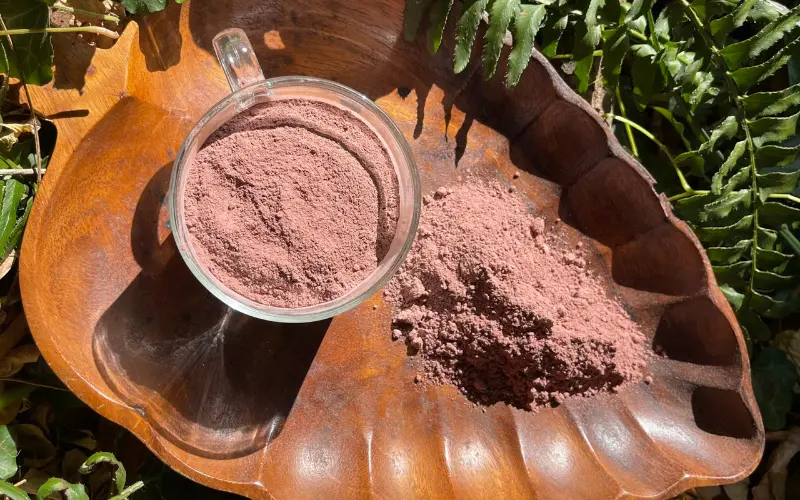
Mimosa hostilis bark powder is a fine powder obtained from the inner bark of the root of the Mimosa tenuiflora tree, also known as Mimosa hostilis, tepezcohuite, or jurema preta. This species is native to tropical regions of Latin America, particularly Mexico and northeastern Brazil.
In its natural state, the bark has a fibrous, dense texture and is rich in plant compounds such as tannins, flavonoids, saponins, and other natural components, making it a highly valued raw material in cosmetics, ethnobotany, and natural dyeing processes. Once dried and ground into a powder, it becomes a reddish-brown material with multiple applications.
Unlike chips or bark strips, Mimosa hostilis root bark powder offers a more practical and versatile form. Its texture makes it easier to mix, apply, and store, and it integrates better into cosmetic formulas, face masks, exfoliants, and handmade soap products.

Preparation of Mimosa Hostilis Bark Powder
Properly preparing Mimosa Hostilis bark powder is key to achieving a fine, uniform texture that is easy to use in face masks, scrubs, handmade soap, and other botanical preparations. To achieve good results, simply grinding the bark is not enough: it must first be completely dry, clean, and free of debris, as moisture can affect the grinding process and the shelf life of the final product. When the material comes from the root and is processed properly, a much finer, more stable, and easier-to-mix root powder is obtained.
After drying, the bark is cut into small pieces, ground until a uniform texture is achieved, and then sifted to remove the coarser particles. If necessary, this coarser material can be ground again until a finer finish is achieved. Once ready, the powder should be stored in an airtight container in a cool, dry place away from light to best preserve its color, texture, and quality.
Basic Preparation Process
| Step | Action | Description |
| 1 | Dry the bark | Make sure the bark is completely dry before starting. This helps achieve a more even grind. |
| 2 | Clean the material | Remove dirt, debris, or any foreign particles so you can work with cleaner raw material. |
| 3 | Cut the bark into small pieces | Break or cut the bark into smaller pieces to make grinding easier. |
| 4 | Grind | Grind it until you get a fine, even texture, ideal for cosmetic and artisanal uses. |
| 5 | Sift | Separate the coarser particles so you are left with a finer, more uniform powder. |
| 6 | Repeat if needed | Regrind the coarser material until you reach the desired texture. |
| 7 | Store properly | Keep the powder in an airtight container in a cool, dry place away from direct light. |
Benefits of Mimosa Hostilis for the Skin

Although this tree is widely known for its connection to skincare, it’s worth taking a closer look at the benefits most frequently highlighted in botanical cosmetics.
Thanks to its content of flavonoids, tannins, and saponins, Mimosa hostilis is associated with antioxidant, soothing, and protective properties. These characteristics have contributed to tepezcohuite being used in products designed to improve the skin’s appearance and support daily skincare.
Among the most notable benefits of Mimosa hostilis bark powder for the skin are:
- helps maintain better-looking skin with improved texture
- promotes a feeling of hydration by reducing water loss
- is associated with the care of blemish-prone skin
- is used in formulas aimed at skin regeneration and comfort
- can be incorporated into botanical face masks and exfoliants
Another of its best-known uses is in hair care, as it is also used in products designed for the scalp and hair care. Additionally, in artisanal cosmetics, tepezcohuite powder is valued for its versatility and its ability to blend with other natural ingredients.
Therapeutic Properties of Mimosa Hostilis

Over time, Mimosa hostilis has been valued in various traditional contexts for its botanical properties. Its natural composition has sparked interest due to its connection to skin health and its use in botanical preparations for external application.
Among the properties most frequently associated with this plant are:
- Support for skin care
- Traditional use in soothing preparations
- Botanical interest due to its antioxidant profile
- Presence of natural compounds useful in plant-based cosmetics
- Application in topical formulas related to skin comfort
It has also been mentioned in botanical preparations linked to general well-being, which has helped reinforce its reputation as one of the best-known plant species within the world of tepezcohuite and Mimosa tenuiflora.
Mimosa Hostilis in Cosmetics
One of the fields where this plant has gained the most prominence is cosmetics. Extracts and preparations derived from Mimosa hostilis can be incorporated into formulations such as lotions, gels, creams, moisturizers, exfoliants, face masks, and soaps.
Mimosa hostilis bark powder is particularly appealing in this field because it integrates easily into beauty and personal care products. Its texture and plant-based origin make it an attractive option for those working with natural formulations, botanical cosmetics, or handmade soap.
Some of the most common uses in cosmetics include:
- face masks
- plant-based exfoliants
- handcrafted soaps
- creams and ointments for external use
- botanical blends for skin care
- skin care formulas containing tepezcohuite
Face Masks and Exfoliators / Face Mask – AHAL Exfoliating Face Mask: This product is described as an exfoliating face mask ideal for all skin types, as it contains a special blend of natural ingredients, including Mimosa Hostilis. Its main benefits include reducing inflammation, preventing acne, and exfoliating the face.XiXänthé Moisturizing Facial Gel: This cream is essentially a lightweight gel that, in addition to refreshing the face, also purifies, tones, and moisturizes the skin, making it ideal for those with oily or acne-prone skin.
Frequently Asked Questions
What exactly is Mimosa Hostilis bark powder?
It is the fine powder obtained by grinding the inner bark of the Mimosa tenuiflora tree. This part of the plant contains bioactive compounds with regenerative and anti-inflammatory properties, widely used in cosmetics and natural dyes.
What is the bark powder used for?
It is used in face masks, soaps, exfoliants, and skin ointments. It is also used as a plant-based pigment in crafts.
What is the difference between powder and shavings?
Shavings are thick, dry strips of bark that must be ground before use. Bark powder, on the other hand, is already processed and ready to mix, apply, or extract, making it more efficient and practical.
How should Mimosa Hostilis bark powder be stored properly?
Store it in an airtight jar in a cool, dry place, away from direct sunlight. This will help preserve its properties for longer (up to 12 months if stored correctly).
Is it safe to use on sensitive skin?
Yes, but it is recommended to perform a skin test before prolonged use. Although it is natural, some people may experience a mild reaction. Avoid contact with the eyes or mucous membranes, and do not use it on deep open wounds.









1 thought on “How to Make Mimosa Hostilis Bark Powder?”
Pingback: Mimosa Hostilis: What It Is, Uses and Origins - MHRBUSA™